


🔬 Laboratories in School
Our school believes that practical learning is essential for a deeper understanding of academic concepts. To support this approach, the school provides well-equipped and modern laboratories where students can perform experiments, explore ideas, and develop scientific thinking.
The laboratories are designed to encourage hands-on learning, innovation, creativity, and problem-solving skills in students.
The school has laboratories for subjects such as Physics, Chemistry, Biology, Mathematics, Computer Science, Home Science, Social Science, General Science, and English Language learning.
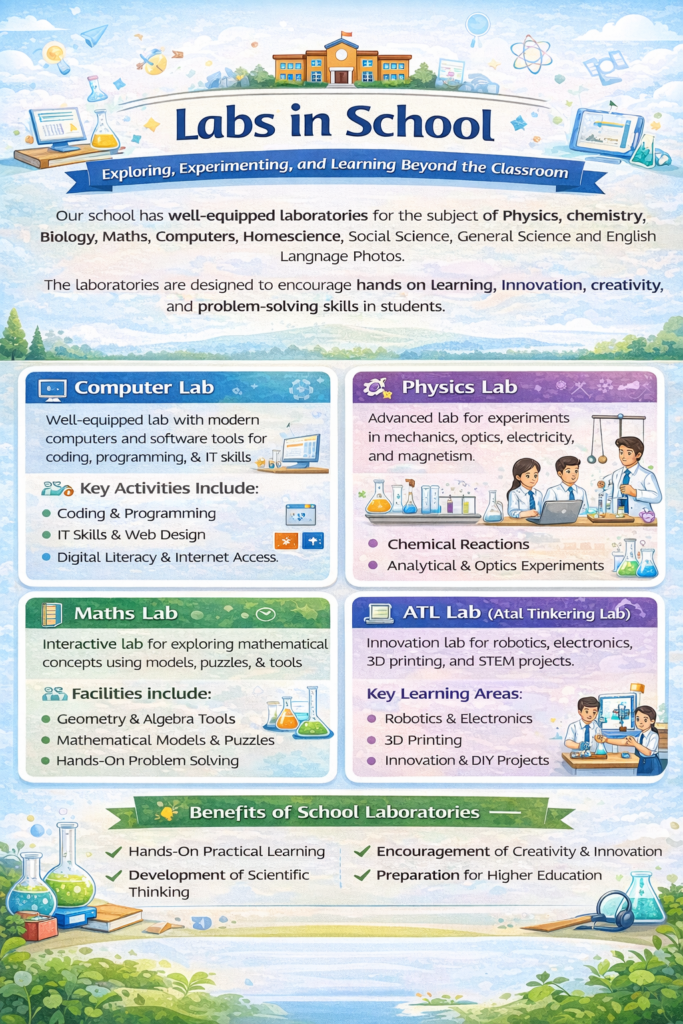
🧪 Labs Available in the School
💻 Computer Lab
The computer laboratory is equipped with modern computers, internet connectivity, and updated software tools. Students learn computer fundamentals, programming, digital literacy, and IT skills.
Key Features
-
High-speed computers
-
Internet-enabled systems
-
Programming and coding practice
-
Web designing and digital learning tools
⚡ Physics Lab
The Physics laboratory helps students understand the fundamental laws of nature through experiments and demonstrations.
Activities Include
-
Experiments on electricity and magnetism
-
Optical and mechanical experiments
-
Measurement and scientific instruments practice
🧫 Chemistry Lab
The Chemistry laboratory allows students to perform chemical reactions and analytical experiments safely under proper supervision.
Facilities
-
Modern laboratory apparatus
-
Chemical analysis experiments
-
Practical demonstrations of reactions
📐 Maths Lab
The Mathematics laboratory helps students learn mathematical concepts through models, activities, and interactive tools.
Learning Activities
-
Geometry models
-
Mathematical puzzles and games
-
Hands-on learning of algebra and measurements
🤖 ATL Lab (Atal Tinkering Lab)
The Atal Tinkering Lab encourages students to explore innovation, robotics, and technology-based learning.
Key Learning Areas
-
Robotics and electronics
-
3D printing and innovation tools
-
STEM-based projects
-
Creative problem-solving activities
🎧 Language Lab
The Language Laboratory improves students’ communication skills, pronunciation, listening, and speaking abilities.
Activities
-
Spoken English practice
-
Audio-visual language learning
-
Pronunciation and conversation training
⭐ Benefits of School Laboratories
✔ Hands-on practical learning
✔ Development of scientific thinking
✔ Better understanding of theoretical concepts
✔ Encouragement of creativity and innovation
✔ Preparation for higher education and research
🎓 Our Commitment to Practical Learning
The school laboratories provide students with opportunities to experiment, observe, analyze, and discover knowledge beyond textbooks. This practical approach helps students build confidence, curiosity, and problem-solving skills, preparing them for future academic and professional success.